Modules

Milking & milk yield

The whole milk chain in one module – from a single milking through the lactation and the tank to the dairy delivery and the booked milk payment. The module appears as soon as your farm profile holds a milkable species – cattle, sheep, goat, horse, donkey, bison, alpaca or llama.

11capabilities
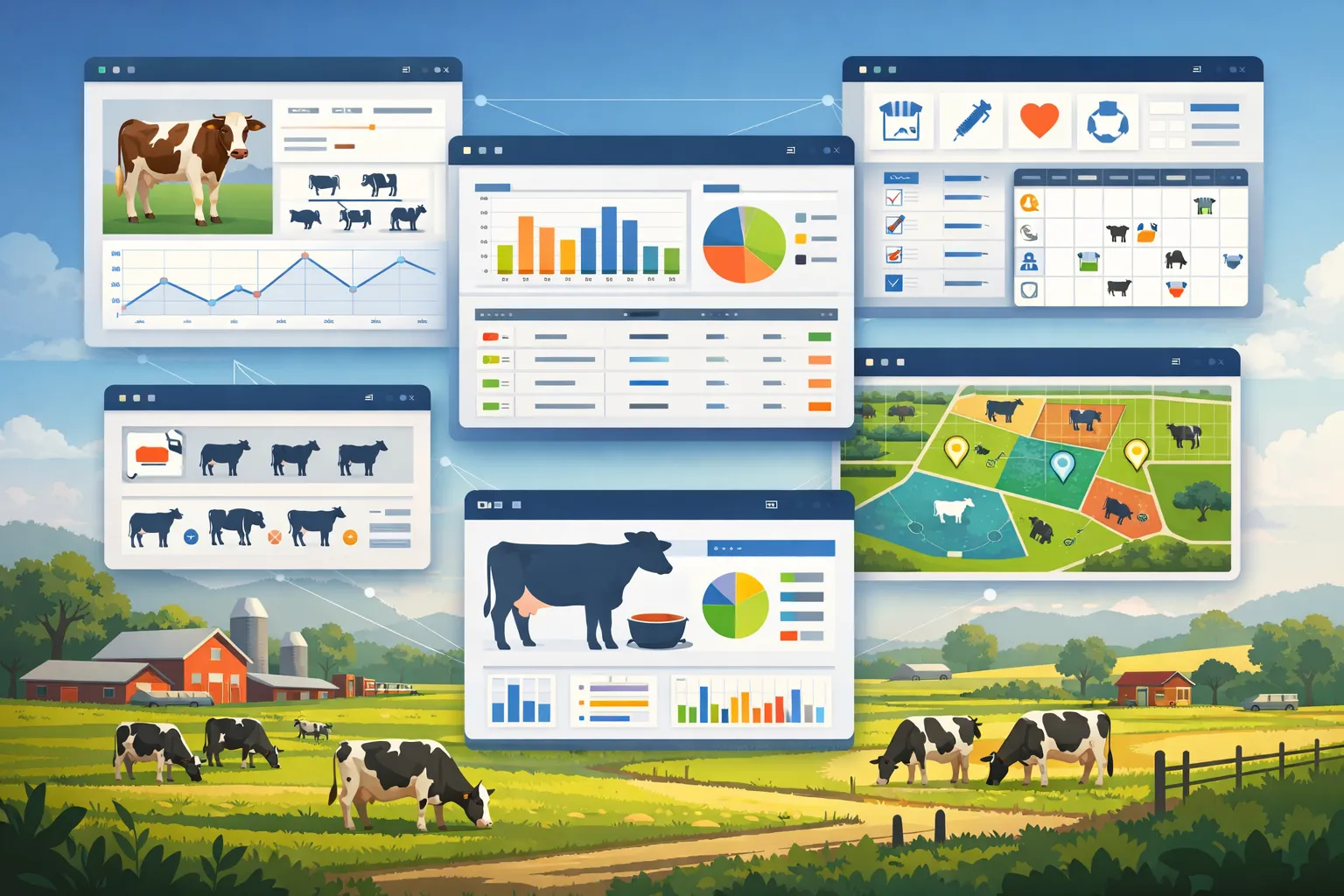
Farmyard backdrop with grazing dairy cows and app windows: an animal profile card with breed icons and a growth chart, bar and pie charts, a table with status checkmarks, a cow at a feed trough, and a pasture map with coloured plots.
capabilities

Milking & milk yield: 11 capabilities

01

Milk yields per animal or per herd

Record an individual milking on the animal or a group milking on the herd, each with the amount in kilograms and an optional milking slot (morning, noon, evening). The amount field accepts arithmetic such as "=12.4+8.1". A second identical entry – same animal, same moment, same source – is rejected, so nothing is counted twice.
02

Milk quality per measurement

Every milking can carry fat, protein, lactose, somatic cell count, urea, conductivity and milking duration. All of it is optional, so a quick amount-only entry in the parlour is never slowed down.

03

Data sources and file import

Each milking carries its origin – manual, bulk entry, milk recording scheme or robotic milking system. The source is set rather than typed, and it can be filtered. You upload the MLP test-day file of your LKV as a semicolon-separated CSV with a UTF-8 header that names “Ohrmarke” (ear tag) and “Prüfdatum” (test date). FarmManager assigns the values to the animal and its lactation via the ear tag and takes over quantity and constituents. Milk from blocked animals is marked as withheld milk, and a repeated import creates nothing twice. Data from a milking robot arrives as a file in the fixed FarmManager column format – there is no live connection.

04

Quick entry for the walk through the barn

The lightning quick-action in the header records a milking in seconds. For a pass through the herd there is “Milking today” as its own menu item – you choose herd and milking slot, optionally milking parlour or robot, and enter only the kilograms for up to 150 animals per herd. Animals with withheld milk are already marked in their row; what is saved is one milking session with all milkings, which you find again on the “Milking sessions” tab of the herd. Alternatively, select several animals in the list and record their milkings in one go.

05

Lactations on the animal

Keep lactations per animal with number, start, dry-off and end date including the reason. A recorded calving opens the lactation automatically, and a calving date corrected later moves it along as long as no lactations overlap. For purchased animals already in milk you create it by hand.

06

Withheld milk documented in a traceable way

Treatments and vaccinations carry their own withdrawal period for milk. Milk can also be blocked without a treatment, for mastitis under observation or for colostrum, for example – on the animal you enter “Blocked until” and a reason, and every milking and the delivery check take that into account. Affected animals show a withheld-milk marker in the animal and herd lists; a milking for a blocked animal is pre-set as discarded with the block reason, in herd entry and import FarmManager sets that itself, and a discarded milking requires a reason. If an animal is under a block on the delivery date, the delivery can only be saved with an explicit release and a reason; that reason is written to the activity log.

07

Deliveries to the dairy

Record every tank collection with delivery date, dairy and amount in kilograms. The quality parameters from the test report – fat, protein, cell count, bacterial count, freezing point, inhibitor test and quality grade – are added once the report arrives. The dairy is an ordinary customer of type processor or cooperative. From your entries, FarmManager calculates quality figures – the geometric mean of the somatic cell count over three months and of the bacterial count over two months against the limits, as the German Milk Quality Ordinance provides, plus the positive inhibitor tests and the quantity-weighted freezing point of the last twelve months. This is an approximation from your own entries and does not replace the dairy's official quality testing.

08

Book the milk payment straight from the delivery

Create the settlement amount as income directly from the delivery row; booking and delivery stay linked. The milk payment therefore reaches your finances without being maintained twice.

09

The bulk tank is a real storage location

The tank is a storage location like any other. If you create it in kilograms, the milkings fill it as a batch, so the fill level shown comes from the amounts actually recorded rather than from an estimate. Withheld milk flagged as discarded does not reach the tank, and every delivery books out the delivered quantity, oldest batch first.

10

Forecasts for milk quantity and milk payment

A dedicated tab on the milkings shows the history so far, the trend and the projection onto the coming months – with the average, the expected monthly amount and the trend direction. What is counted is the quantity milked including withheld milk, so not the deliverable quantity. The milk deliveries have their own forecast for the delivered quantity and milk payment of the next month, plus the projection to the end of the year and the trend of the milk payment.

11

Analyses by source and milking slot

Monthly volume plus charts by data source and by milking slot show how performance develops and whether the morning and evening milkings are drifting apart. The average lactation curve of your farm shows the daily quantity per animal over the days in milk.

Common questions

Frequently asked questions

Quick answers to the questions farms ask most often about this module.

Modules

Other modules

Explore more modules from this area — each one is built to work seamlessly with the others.

Animal Management

Animal Health

Animal Welfare

Built for real farms and modern operations

Scale from small farms to large enterprises.