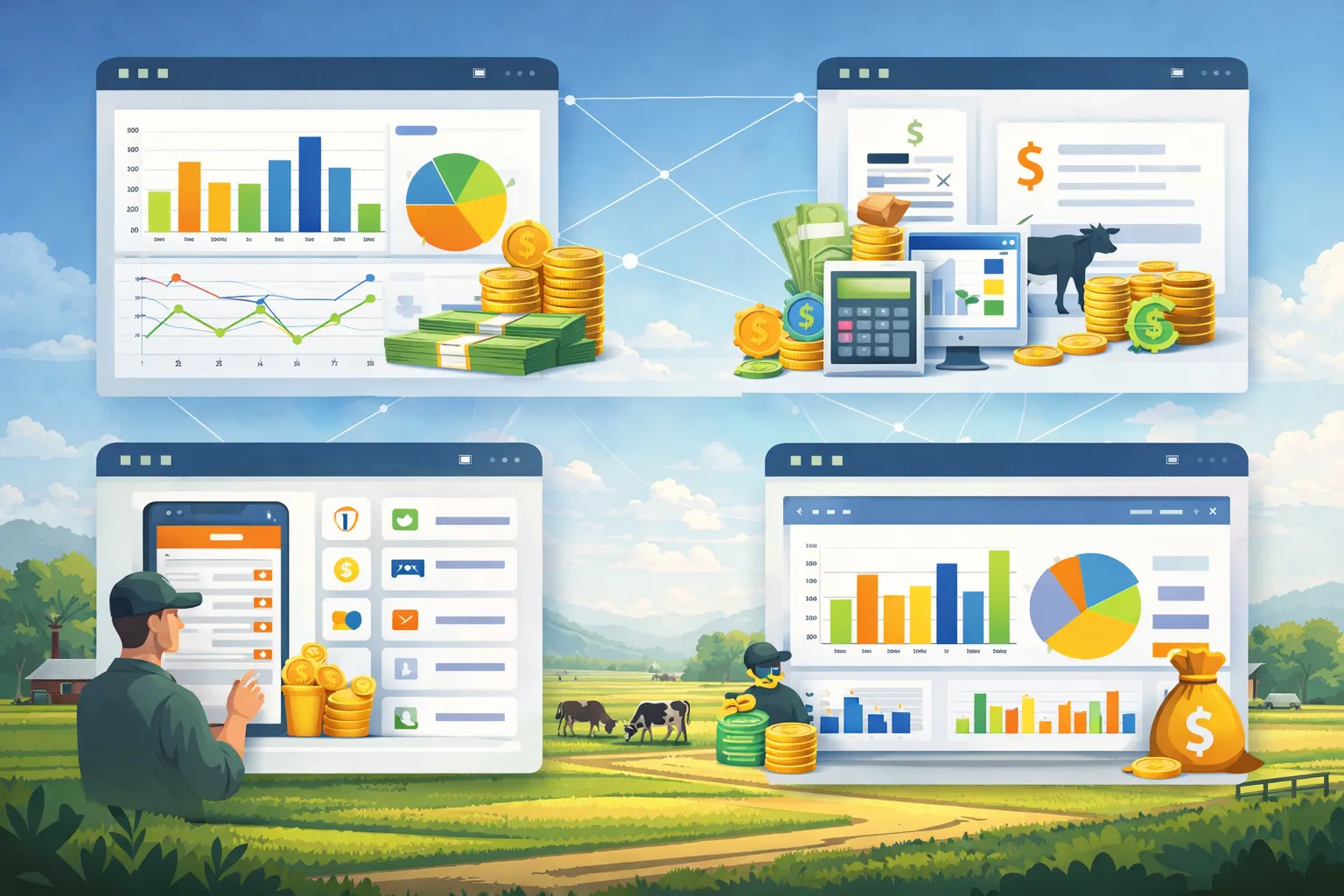
Expense Tracking
Categorize every cent spent on feed, fuel, chemicals, and labor. Monitor spending trends.
Turn your farm accounting from a burden into a competitive advantage. Gain full visibility of your margins and cash flow – including automatic machine depreciation per German § 7 EStG.

Categorize every cent spent on feed, fuel, chemicals, and labor. Monitor spending trends.
Track livestock and crop sales, subsidies, insurance payouts, and other income. Monitor real-time status of all revenue streams.
Generate reports for custom periods (journal, budget overview, cash flow, forecasts, P&L, quick view, tax reports, subsidy evaluations) for full insight into your financial situation.
Machine depreciation is calculated automatically – linear or declining balance, based on the official BMF table "Agriculture and Forestry" (tractors, mowers, trailers, ploughs and many more). Annual depreciation, cumulative book value and immediate write-off for low-value assets (GWG) under €800 net flow directly into tax report and P&L.
Link every expense and income to an animal, field, machine or contractor job. Margins per parcel, herd, machine or client emerge automatically – ideal for sound investment decisions and cost optimisation.
Receive and manage electronic invoices (e-invoice) directly in the system – in line with the German e-invoicing obligation.
Stop double-entering what already happens elsewhere in FarmManager. Incoming e-invoices, contractor-job costs, animal purchases and sales, completed harvests and monthly wages can post themselves straight into your ledger as the right income or expense – no manual booking. Every auto-entry is GoBD-safe (written into the tamper-evident journal), idempotent (re-running never creates duplicates) and reversible, so deleting or reverting the source record cleans up its booking too.
Each connection books exactly one entry from its source – an ingested e-invoice becomes an Expense (opt-in per farm), a contractor job's actual cost becomes an Expense at invoicing while its revenue stays an Income, a purchased animal books a livestock Expense and a SOLD animal a sale Income, a completed harvest books a crop-sale Income from yield × sale price, and a scheduled monthly run posts a wage Expense per employee from completed work-plan hours × hourly wage. Edit the source and the booking updates; revert or clear it and the booking is removed.
Log incoming and outgoing commercial correspondence per § 257 Abs. 4 HGB as a searchable register. For each letter you set direction (Incoming/Outgoing) and type: quote, order, order confirmation, delivery note, complaint or other.
Generate hybrid ZUGFeRD/Factur-X invoices in the EN16931 profile (PDF/A-3 with embedded CII XML) or pure XRechnung 3.x XML for public-sector buyers. Units are mapped to UN/ECE Rec 20 codes (piece→H87, h→HUR, t→TNE, kg→KGM, l→LTR, lump sum→C62).
A monthly forecast over 6, 12 or 18 months (default 12) compares expected inflows and outflows per month and chains them into a closing balance: opening balance + inflows − outflows. Each month's closing balance becomes the opening balance of the next month. An optional as-of date sets the starting month.
The instalments of your running loans appear as a planned outflow in the liquidity forecast — in the month they actually fall due under their payment frequency, taken from the amortization schedule and never to be recorded a second time. The same goes for the annual lease rent, as soon as you store the due month on the lease contract — it then shows up in exactly that month until the contract ends. Without that entry it deliberately stays out, because FarmManager does not guess the date.
The BZA breaks down every operating branch into four tiers: output, − variable costs = contribution margin, − direct fixed costs − overhead allocation = result after fixed costs, − imputed costs = branch result. Positive results are shown in green, negative in red; the "Total" row sums all branches.
Use the "Export DATEV posting batch" action above the expense list to generate an EXTF posting-batch file (format version 700, data category 21). Expenses (debit) and income (credit) for the selected period land together in a CSV your tax advisor can load directly into DATEV.
Record every loan with lender, loan amount, nominal interest in percent p.a., term in years and status from active to repaid. Choose the matching loan type per loan – the constant annuity loan, the instalment loan with constant repayment or the bullet loan with repayment at the end of the term – and store interest-only grace years as well as the payment frequency monthly, quarterly or annually, which feeds into the calculation
The amortization calculator builds the full schedule for each loan from interest portion, repayment portion, instalment and the remaining debt until full repayment, and reports the total interest accruing over the full term per loan. Metrics summarize loan amount, current remaining debt and the annual debt service across all active loans
Bring together all farm policies with insurer, policy number, insured object and expiry date in one place. Assign every policy to a type – from multi-peril and hail through operational liability, animal, machinery and buildings to legal expenses – and store the sum insured, deductible and annual premium, so you keep an overview of the premium burden of the whole farm
Flag premium-subsidy-eligible policies and record term and notice period in months so no cancellation date is missed
Record every lease contract with lessor, contact details and an optional link to the leased field from your land management, as well as with start, end, notice period in months and the status active, terminated or expired
From the contract end and the notice period on file FarmManager works out the last possible termination date and gets in touch around 90 days beforehand — in the app and by email, with a 14-day grace period should the date already have passed. Nothing is ever terminated automatically — you get reminded, the decision stays yours. For contracts without an end date or without a notice period the warning cannot be calculated.
Record the leased area in hectares, the annual lease rent and the lease rent per hectare as a basis for your field calculation — plus, optionally, the due month with which the lease rent feeds into the liquidity forecast
Metrics show the average lease rent per hectare; an analysis bundles expiring lease contracts by year for forward-looking planning
Structure the holding up to four levels deep — farm, area, barn or field, detail. Barns, fields and contract jobs are adopted from your own records and keep their names; your own cost centres sit alongside them, with an optional code for the books. Seven cost centres for time without a fixed place ship with the product — yard, errand, workshop, travel time, training, administration and other.
Every stamped hour carries its booking target, so the hierarchy shows how much working time falls on which area. Cost centres can be filtered by kind and exported. When one is no longer needed you set it to not bookable — it leaves the picker but stays visible on the time already booked to it.
Quick answers to the questions farms ask most often about this module.
Explore the rest of the platform — every module is built to work seamlessly with the others.

Optimize daily tasks and ensure your team works with absolute clarity – a central calendar and granular tasks keep everyone in sync, from planning right through to field execution.

Maintain a digital twin of your entire herd. Beyond simple tracking, FarmManager provides deep insights into lifecycle events, genetics, and nutrition performance.

Keep your herd healthy and compliant – vaccinations, veterinary treatments, medications and automatic withdrawal periods, fully documented.

Make animal welfare verifiable – housing, inspections, biosecurity, mortality reports and transports, all structured and documented.

The whole milk chain in one module – from a single milking through the lactation and the tank to the dairy delivery and the booked milk payment. The module appears as soon as your farm profile holds a milkable species.

Manage your fields with geographic precision – interactive polygon maps, documented field activities and VDLUFA soil samples including Nmin form the data foundation for crop management and fertilization.

Plan crops and rotations based on data – with live rule validation, catch crops, harvest documentation and EU conditionality (GAEC).

Document crop protection applications in a legally compliant way – applications, products, certificates of competence and equipment all in one place.

Fulfil the German Fertilization Ordinance digitally – fertilizer demand calculation, closed periods, Annex 5 and manure transports, currently with curated reference values for the German state of Hesse (LLH).

Minimize downtime and maximize the lifespan of your heavy equipment. From fleet inventory through preventive maintenance scheduling with dual intervals (operating hours OR months), compliant safety checklists and spare-parts inventory all the way to tax-grade depreciation (AfA) per German § 7 EStG – everything in one platform.

Connect your machines to FarmManager and watch your fleet live on the map – position, operation and utilisation in one place.

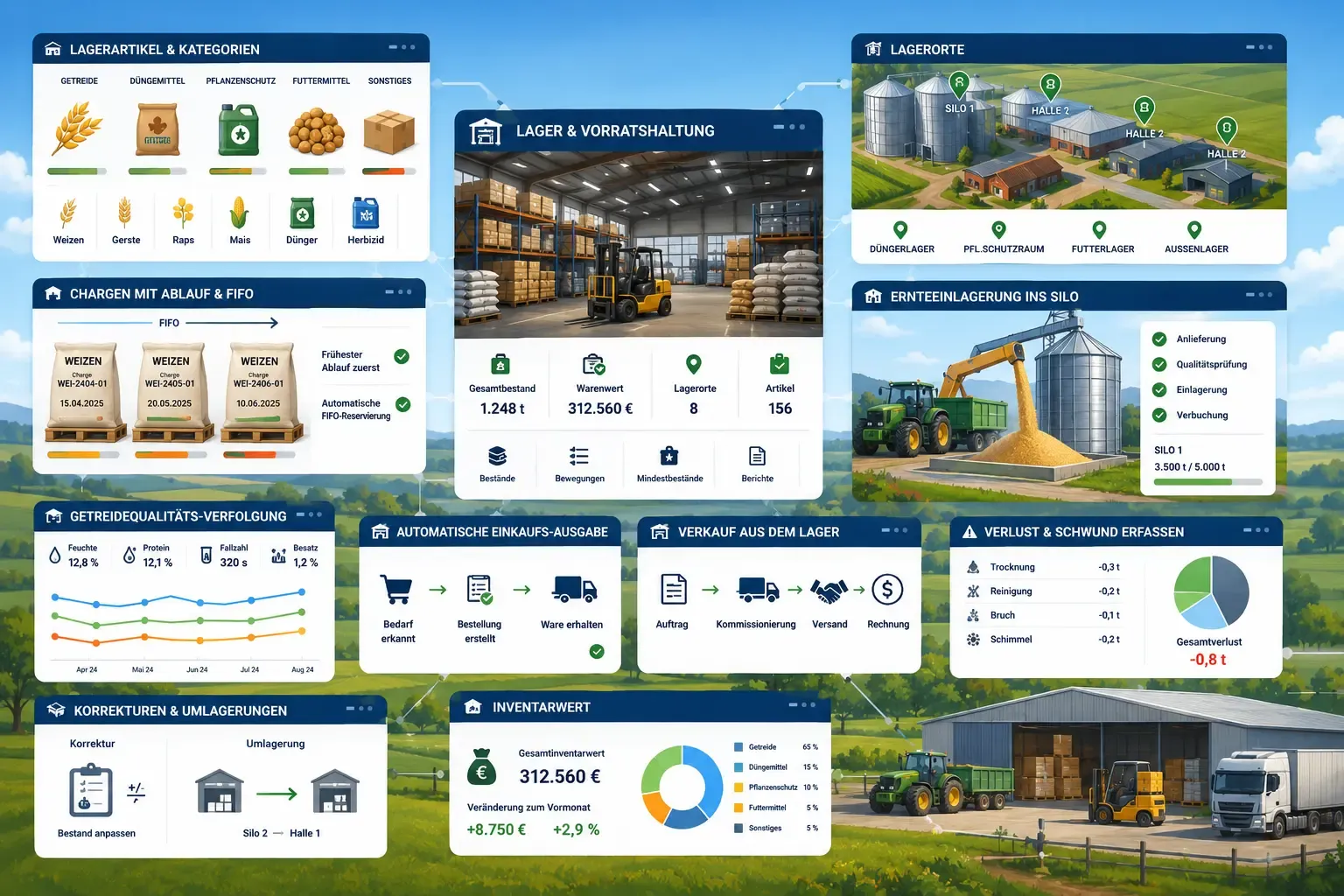
A complete warehouse for your farm inputs and your harvest – storage locations, dated and expiring batches with FIFO valuation, and a signed movement journal that books your finances automatically. From the fuel tank to the grain silo, always know exactly what is in stock, what it is worth and where it came from.

Plan shifts, employment contracts, vacations and working hours in one place. The intelligent shift generator automatically respects contracts, absences and the German Working Time Act (ArbZG) — with fair distribution across all staff.

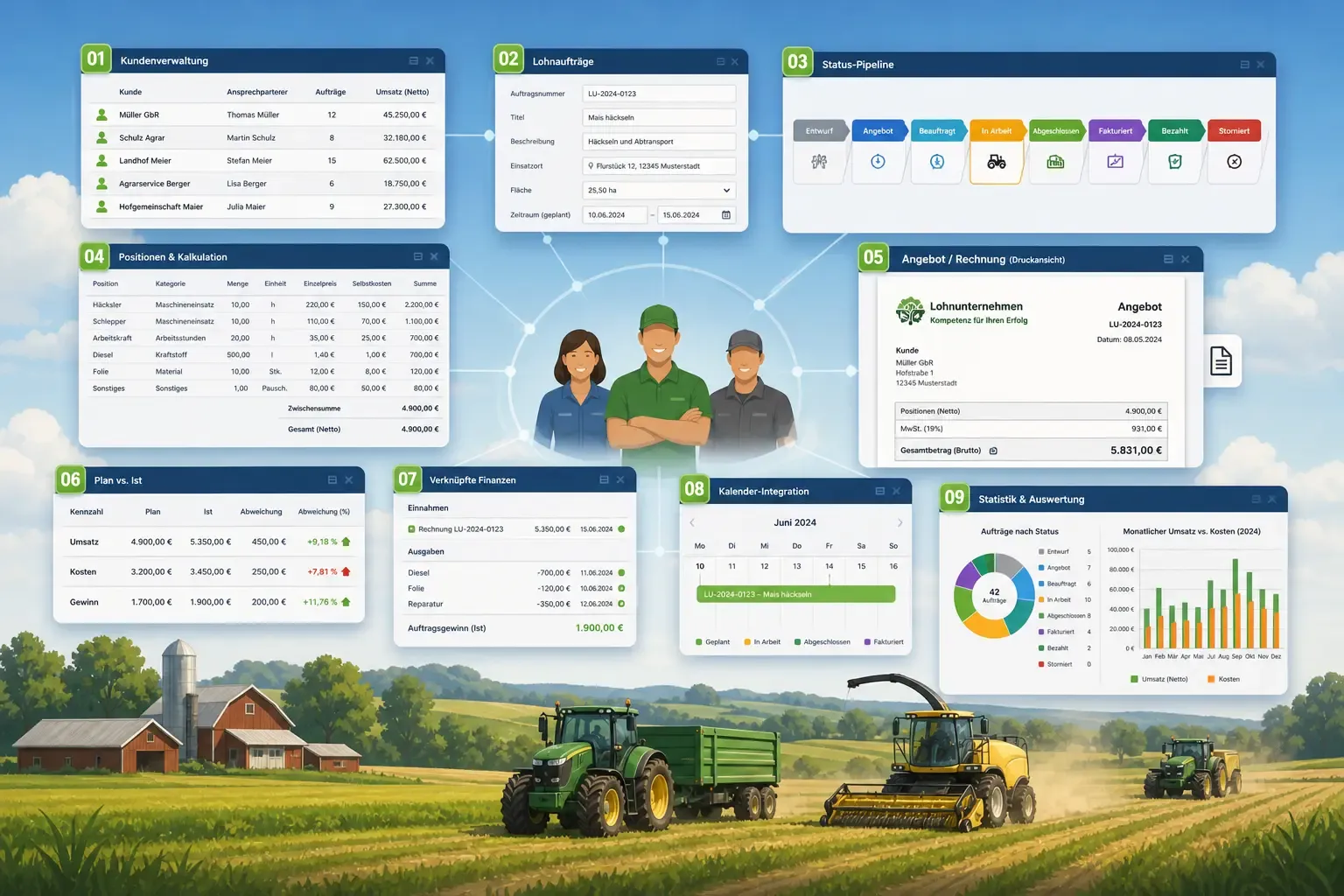
Manage customers, contractor jobs and the entire invoicing workflow in one place – from initial quote to paid invoice, with planned vs. actual analysis, linked finance entries and a print-ready view.

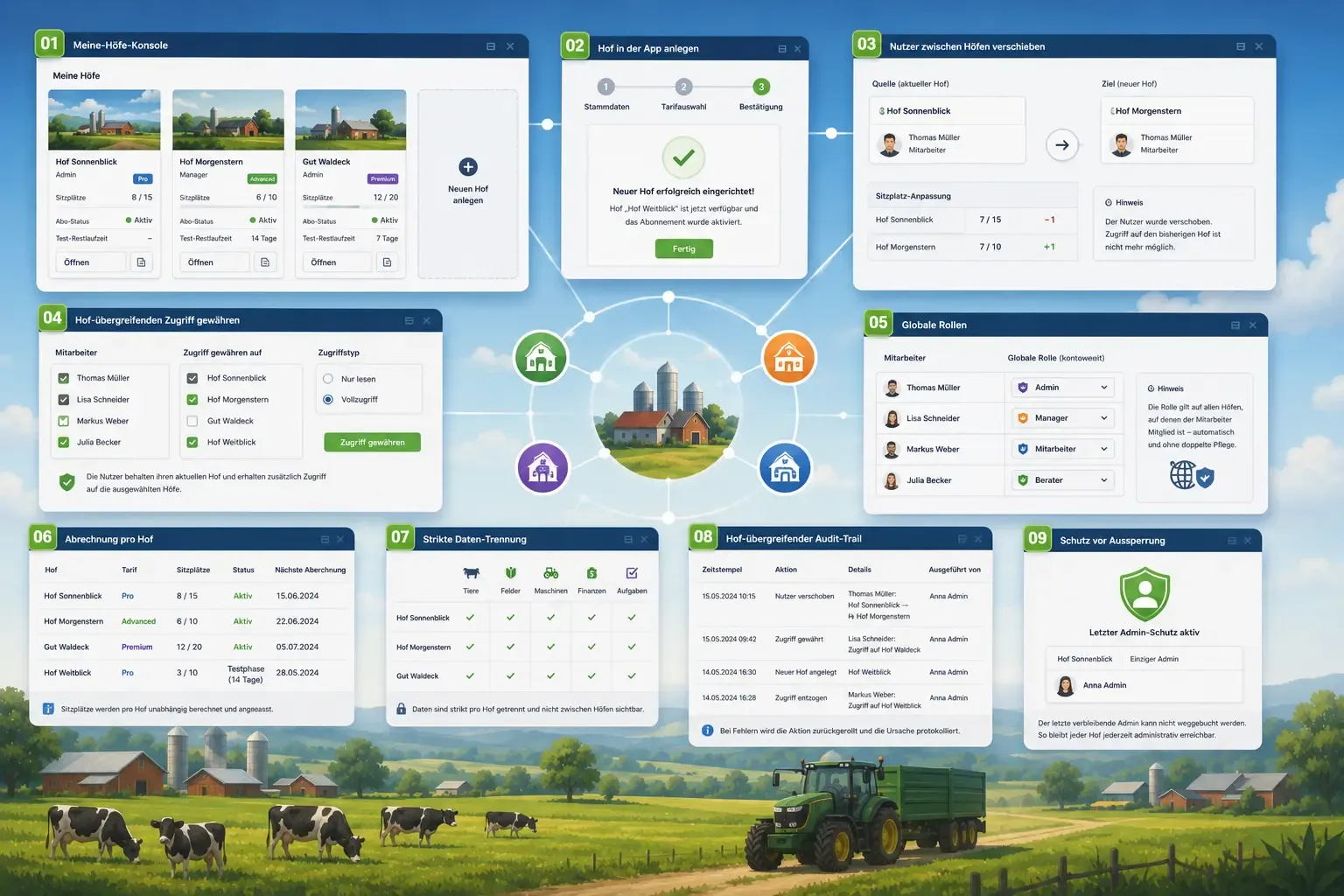
Run multiple farms under a single account – with separate billing per farm, strict data isolation and the ability to move staff between operations or grant them access to additional farms.

Fulfil your reporting and record-keeping duties as an agricultural employer digitally — encrypted social-insurance profiles, DEÜV report files, monthly payroll data for payroll processing and A1 postings, GDPR-compliant and PII-safe.

Make food safety, occupational safety and provenance provable — HACCP self-checks, seamless traceability from sale back to a purchased batch, a central supplier directory and risk assessments under ArbSchG, each with automatic due-date reminders.

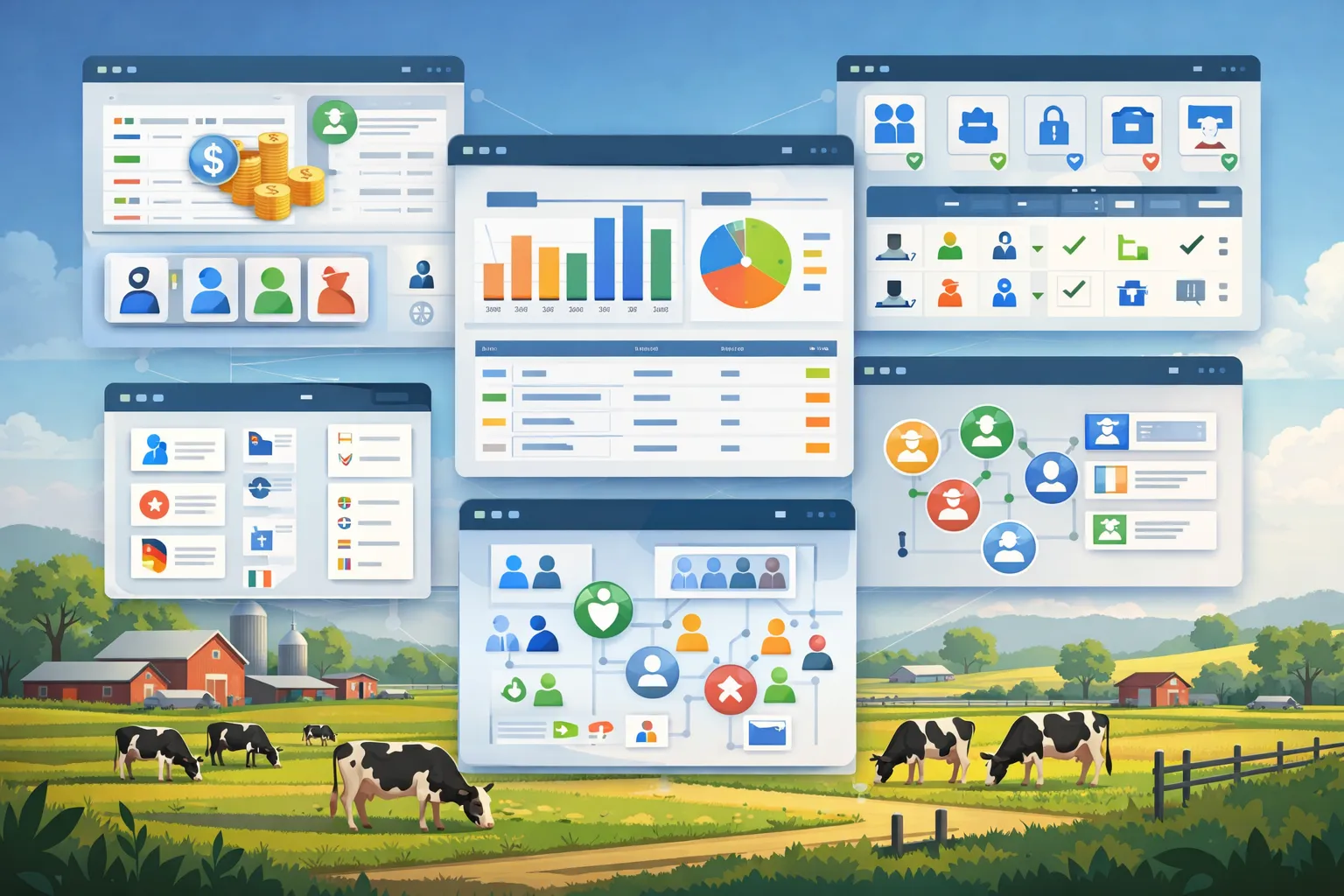
Scale your agricultural business with advanced organization tools and granular security controls.
Scale from small farms to large enterprises.