01
Planting Plans
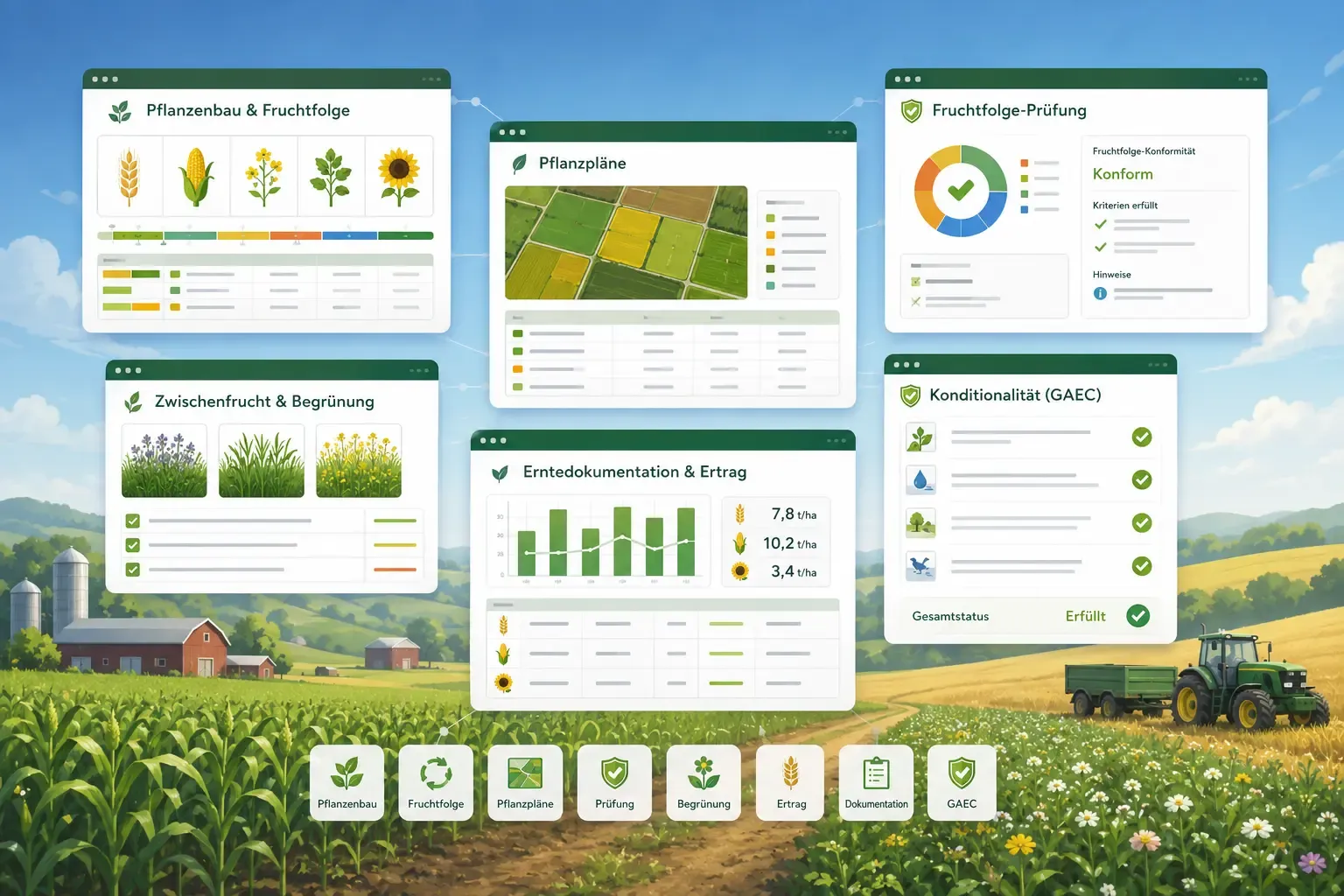
Plan multi-year crop rotations based on the previous main crops of each field. Automatically get a projected harvest date based on crop type and sowing time. Everything at a glance for better harvest planning.
Plan crops and rotations based on data – with live rule validation, catch crops, harvest documentation and EU conditionality (GAEC).
Plan multi-year crop rotations based on the previous main crops of each field. Automatically get a projected harvest date based on crop type and sowing time. Everything at a glance for better harvest planning.
When you create a planting plan, FarmManager checks the planned crop in real time against the previous main crops on the same field. Violations of configured rotation rules (e.g. oilseed rape within 4 years of the previous one) surface with severity — info, warning or violation. If the same crop is planned again after three plantings in a row, FarmManager automatically reports a monoculture as a hint. The rules for cereals, maize, oilseed rape, sugar beet, sunflowers, potatoes and legumes are stored as reference data; you cannot add your own rules.
Flag planting plans as catch crops. Pick the catch crop type and the termination method — frost kill, autumn/spring mulching or autumn/spring incorporation. Catch crops are correctly skipped in the rotation chain, so they don't break it, and in the farm's GAEC 7 assessment a catch crop of the current year counts as crop rotation. For the fertilizer demand calculation you select the catch crop on the DBE entry itself; it is not taken over from the planting plan.
After the season, capture the actual harvest date, harvested quantity, quality grade (e.g. bread wheat, feed grain), water content and harvest notes. Yield per hectare is computed automatically from quantity and field size and shown per harvest year in the 3D crop-rotation timeline.
For every crop plan, FarmManager shows the contribution margin – the revenue, i.e. realised sales from storage or harvested quantity times sale price, minus the recorded costs of the field work, broken down by sowing, tillage, fertilization, plant protection, harvest and other, in euros and per hectare. A ranking of all fields of the current harvest year with the farm total is available in the field list. It is an advisory figure for your decisions and not an accounting document; only costs that you have recorded on field work are taken into account.
Keep track of EU conditionality requirements (GAEC – good agricultural and environmental condition) and document compliance per field. FarmManager checks every parcel against the standards GAEC 1, 2, 3, 4, 5/6, 7, 8 and 9 and lists each issue right where you work. Findings appear per field in the conditionality tab and farm-wide in a holding-status overview, colour-coded by severity (info or warning) so the most urgent problems stand out at a glance. Each finding names the standard and the exact reason — for example arable land kept as grassland past the 5-year mark that must become permanent grassland, a missing or too-narrow water buffer strip, an erosion-prone field without minimum soil cover, an arable field with too few different crops in the last three years, or a sensitive permanent grassland flagged against conversion.
On the reference date, by default 15 May, FarmManager automatically creates a yearly snapshot of each field's GAEC profile — one record per field and year that in FarmManager can only be created and read, not edited or deleted. Pick any two years and see a live field-by-field diff of all 13 conditionality attributes (land-use category, sensitive grassland, wetland and peatland flags, erosion risk class, water buffer strip and width, minimum soil cover, eco-schemes, area and more). Changed values are highlighted and dates, decimals and eco-scheme sets are compared correctly, so you can trace how a parcel evolved between application years.
Per field a column shows the harvest years as segments together with catch-crop bands - up to 15 years back as a selectable window. Every main segment is checked against the rotation rules and violations are made visible in the timeline.
A holding card summarizes the overall conditionality (GAEC) verdict together with the number of fields with findings. The standards GAEC 1 (permanent grassland), GAEC 7 (crop rotation) and GAEC 8 (non-productive areas) are each kept as their own traffic light with a holding verdict. For GAEC 1, FarmManager compares the permanent-grassland share with the reference share (base year 2018) that you store; without a reference it stays at monitoring. GAEC 7 exempts organic farms and farms with less than 10 ha of arable land, and the minimum share of non-productive area under GAEC 8 is currently treated as voluntary. The “Conditionality status” dialog shows shares, exemptions and the findings of all fields.
Create reusable crop and cover-crop plans (crop, status, cover-crop type, termination method) as a template and apply them when creating a new planting plan. Field, sowing/harvest dates and harvest results are excluded.
Quick answers to the questions farms ask most often about this module.
Explore more modules from this area — each one is built to work seamlessly with the others.
Scale from small farms to large enterprises.