Modules

Fertilization Management (DüV)

Fulfil the German Fertilization Ordinance digitally – fertilizer demand calculation, closed periods, Annex 5 and manure transports, currently with curated reference values for the German state of Hesse (LLH).

9capabilities
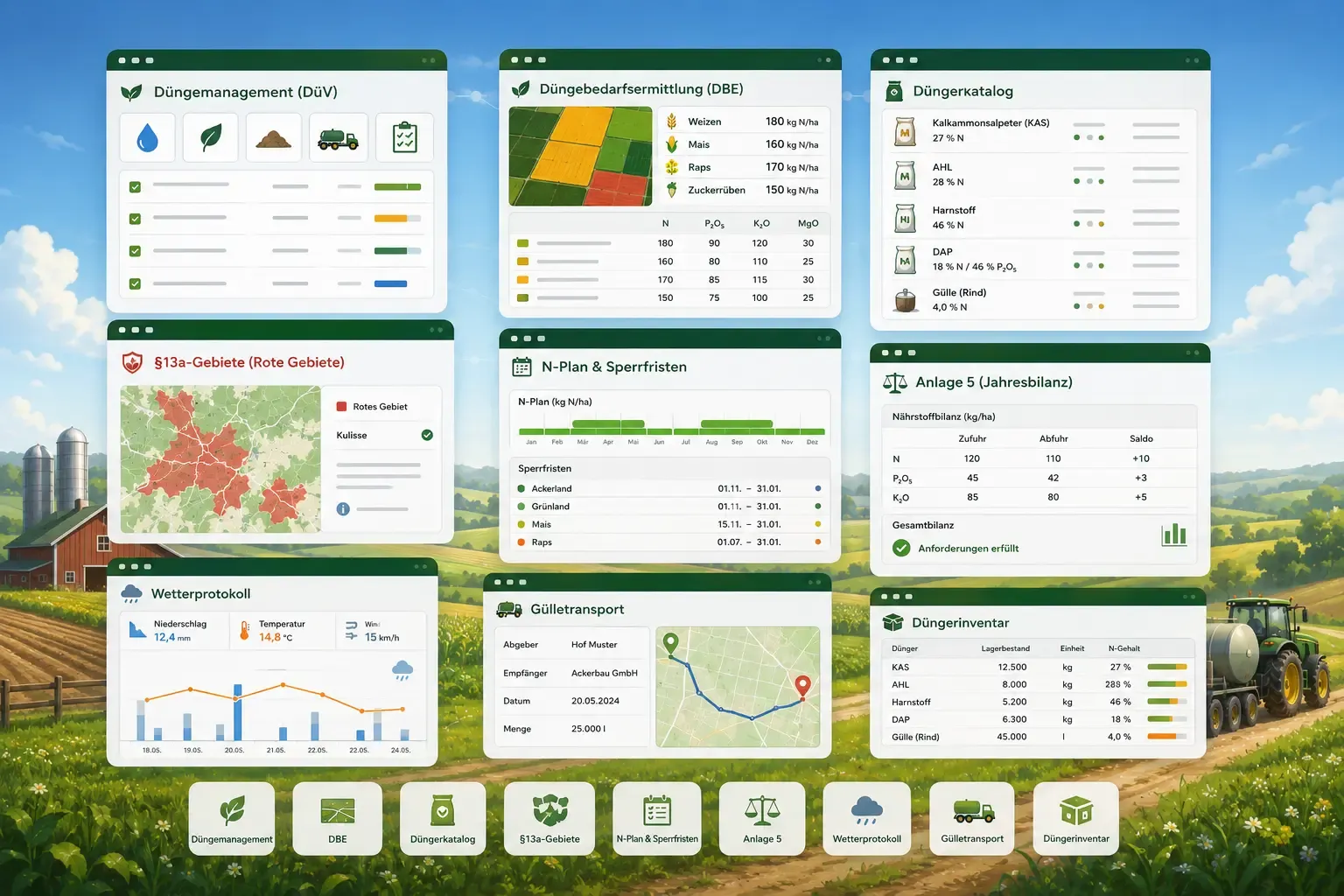
Green app windows over farmland with a slurry-tanker tractor: a per-crop fertilizer-demand calculation, a red-shaded map of restricted zones, a closed-period calendar bar, a nutrient-balance table, and a manure-transport route on a map.
capabilities

Fertilization Management (DüV): 9 capabilities

01

Fertilizer Demand Calculation (DBE) — Hesse

Automatically calculate N, P₂O₅ and K₂O demand per field based on crop, target yield, previous crop, catch crop, soil texture, Nmin value and humus level. Currently based on the LLH Hesse reference values (DBE workbook v5.2), including the Hessian special rule under which only the offtake is fertilized at soil P values above 20 mg P₂O₅/100 g. Nitrogen carryover from last year's organic fertilization and three-year compost history is factored in per DüV Annex 3. Additional German states are in preparation.
02

Fertilizer Catalog

Maintain organic and mineral fertilizers with full nutrient content (total N, NH₄-N, P₂O₅, K₂O, MgO, S). Use system templates for slurry, farmyard manure, compost and common mineral fertilizers such as KAS, urea and AHL or capture your own analyses — chargeable nitrogen is calculated automatically using the DüV minimum-credit rate. For your own fertilizers you also store the barcodes of the containers, so that a scan opens the fertilizer.

03

Nitrogen Fertilization Plan (N-Plan) & Closed Periods

Plan multiple fertilizer applications per field with date, rate and unit. Applied N, P₂O₅ and K₂O are calculated automatically and compared to demand. When you enter an application, FarmManager shows notices and blocks nothing – a warning under the date if the application falls in a nitrogen closed period, a warning on the distance to water under § 5 DüV if the field borders a recorded water body, the farm-wide 170 kg status of organic fertilization and a notice if an application was documented later than § 10 DüV provides (“Documented on”). The closed periods (Sperrfristen) of the Fertilizer Ordinance also appear as a general marking in the team calendar. Whether a closed period applies to the individual field is not distinguished by the warning or the calendar.

04

Annex 5 (Annual Balance)

One-click generation of the per-field annual fertilization balance per DüV § 10 (Annex 5). Demand, applied amounts, balance and the 170 kg/ha organic-nitrogen control value are produced print-ready for the 31 March filing deadline; the balance does not replace the per-field documentation under § 10 Abs. 1 DüV. In the export menu of the DBE plans you also download the hash-chained change history of plans, field demands and applications – including deleted entries – as a JSON archive that you can file for retention under § 10 Abs. 3 DüV.

05

Weather Log per Activity

Capture temperature, humidity, wind speed, precipitation and general conditions for every activity — especially fertilizer applications. The weather log is stored alongside the activity and later shows under which conditions the work was done; you enter the values yourself, and no legal check takes place. It belongs to every field activity and is available in every tier, starting with Lite.

06

Manure Transport

Record delivery and receipt of manure – slurry, farmyard manure, liquid manure, digestate, poultry manure, compost – with quantity in t or m³, nitrogen and phosphate content in kg, holding number and name of the originating and receiving farm, carrier and document number; you flag transports across a state border as cross-state. Every transport carries the status “Recorded” or “Reported” with the reporting date. FarmManager derives from quantity and border crossing whether a transport is subject to reporting; if the report stays open past the deadline, FarmManager marks the transport “Report open” and reminds you. You submit the report yourself; for your WDüngV report you export the transports as CSV. Key figures on nitrogen and phosphate per year, the distribution by direction and a forecast of transport quantities come on top.

07

Facility Register per WHG §§ 62/63 with Automatic Classification

Record every stationary facility handling water-hazardous substances: JGS facilities (liquid manure/slurry/silage), heating-oil/diesel tanks, biogas/digestate storage, and plant-protection and fertilizer stores – with substance/medium, volume (m³ or l), construction (above-/below-ground), wall design, leak detection and location in a water-protection area (zone I–III) or flood area (HQ100). From volume and water-hazard class (WGK 1/2/3), the software derives hazard level A–D per § 39; for generally water-hazardous substances such as slurry (AWG) there is no level. The form shows the notification duty (§ 40) and inspection duty (§ 46) as an informational note including a recommended inspection interval; heating oil/diesel is subject to separate thresholds of 10 m³ or 1 m³ in water-protection areas. For each facility you record the expert inspection with the expert or specialist company, the notification date under § 40 and, on the self-monitoring tab, every check under § 55 with finding and defects. FarmManager calculates the next inspection date and the next self-monitoring from the intervals, reminds you of due inspections and shows in a forecast which expert inspections are due in the next twelve months. Purely informational – you still check the official text of the German ordinance on facilities for water-polluting substances (AwSV) and state law yourself.

08

Storage Capacity Proof per § 12 DüV

The proof compares projected storage demand (target) against existing usable capacity (actual) per physical state (liquid/solid) and shows the result as a traffic-light indicator with progress bar. The mandatory storage duration is set automatically – liquid farmyard manure at a minimum of 6 months, raised to 9 months at a livestock density above 3.0 LU/ha or when no own spreading area is available; solid manure and compost at 2 months. The rationale (standard / high livestock density / no own area) is shown under the calculation basis. If storage space is missing, the shortfall is flagged in red along with how many m³ or t are needed. FarmManager applies the slurry accrual as a guide value for cattle and pigs; for other species and for solid manure you enter the accrual in the manure-storage settings, where the storage duration (1 to 24 months) and the “no own spreading area” option can also be adjusted. Purely informational – no warranty, does not replace an official assessment.

09

All Containers in One 3D View

Silos, bunker silos and tanks from the store appear with fill level and minimum-stock marker, plus the litres fuelled in the last 12 months split by store and external. Per manure-storage facility the bar shows the storage demand per Section 12 DüV (required storage duration in months) against the available capacity; red means a shortfall in the capacity proof. Silos, bunker silos and tanks are available from Pro; the manure-storage bars from Basic.

Common questions

Frequently asked questions

Quick answers to the questions farms ask most often about this module.

Modules

Other modules

Explore more modules from this area — each one is built to work seamlessly with the others.

Land Management

Crop Management & Crop Rotation

Plant Protection

Fleet & Machinery

Telematics & Live Fleet Map

Built for real farms and modern operations

Scale from small farms to large enterprises.