Modules

Land Management

Manage your fields with geographic precision – interactive polygon maps, documented field activities and VDLUFA soil samples including Nmin form the data foundation for crop management and fertilization.

13capabilities
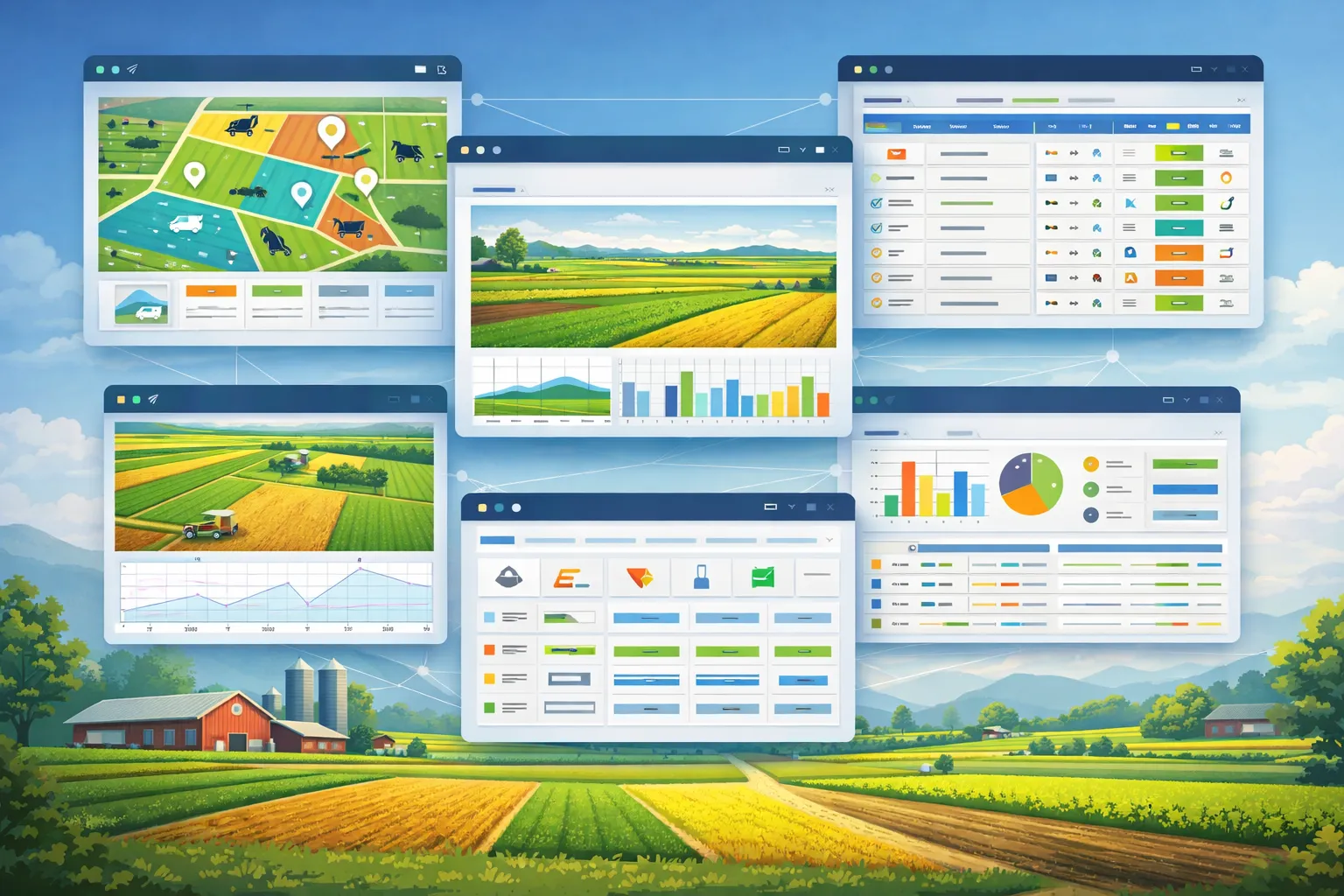
App windows over a patchwork of fields: an aerial parcel map with coloured zones and location pins, aerial photos of arable land with bar and trend charts, and a data table with icons and status rows.
capabilities

Land Management: 13 capabilities

01

Polygon Maps

Map land boundaries precisely with interactive polygon tools. The field size in hectares is derived automatically from the drawn polygon (shoelace algorithm on a spherical-earth projection). Store ownership details, soil types and environmental regulations for each plot.
02

Paddocks within a field

Subdivide a field into individual paddocks directly on the map. Drawing is constrained to the parent parcel's area and automatically prevents neighbouring paddocks from overlapping. All paddocks appear together on an overview map, and you can start a grazing plan straight from a paddock.

03

Navigation to fields and paddocks

Start directions directly from a field or a paddock – via a map service on desktop or your device's navigation app on mobile. If the map point is missing, you get an explanatory note.

04

Field Activities

Track irrigation, fertilization, harvests and other events per field. View all details, automatically track costs in FarmManager and plan future activities. Optionally record the machine used, operator, area worked in hectares and hours per activity.

05

Soil Samples (VDLUFA & Nmin)

Maintain lab soil samples per field with sample reference, lab (e.g. LUFA), soil texture, pH, humus percentage, plus P₂O₅, K₂O and MgO in mg/100 g following VDLUFA. Three Nmin layers (0–30 / 30–60 / 60–90 cm) sum automatically into the total Nmin value. The 6-year DüV validity is tracked with a status badge and an "expired samples only" filter. The most recent sample feeds the field's DBE automatically.

06

Water Bodies & GAEC Buffer Strips

Map the surface water bodies adjoining each field – watercourses, standing water, ditches or coastal water – with their geometry, water type and the recorded distance from the field boundary to the bank. FarmManager uses that mapped parcel-to-water distance to drive the GAEC 4 buffer-strip check automatically — whenever a field lies closer to water than the statutory minimum buffer width (3 m by default), it raises a conditionality finding. A mapped water body always takes precedence over a manually flagged buffer, so you get one accurate result per field instead of duplicate warnings.

07

Import Field-Block Cadastre (InVeKoS) and Reconcile

Upload the official InVeKoS field-block cadastre of your German state as a zipped shapefile or as GeoJSON. Set the state code and the EPSG code of the source coordinate system, e.g. 25832 for ETRS89/UTM32; for WGS84 GeoJSON no entry is needed. Every field block is stored with its FLIK, the state and the official area in hectares. Every field is then assigned to the field block that contains it and takes over its FLIK; a FLIK already set is kept when there is no match. In the reconciliation you see FLIK and official area next to your drawn area, with the variance in hectares and percent. Every import run is logged with file, source, status and the field blocks read, created and skipped.

08

Bring Fields in from Your Aid Application

Upload the geodata export of your aid application – from iBALIS, FIONA, ANDI or ELAN, for example – as a ZIP with shapefile, as GeoJSON, KML/KMZ or GML, up to 50 MB. FarmManager detects the format and the coordinate system itself; supported are ETRS89/UTM 32N and 33N, WGS84 and Web Mercator, and where the file states none, the assumption is flagged as a note and can be changed. Before anything is written, a review step shows every field individually with hectares, FLIK and land use, plus the total across new and existing fields – deselectable row by row. A second import creates no duplicates: recognised fields are refreshed in outline, size and FLIK, while name, land type, soil and notes stay as you entered them. A field split by a road is broken up into several fields in the process. It is a file import, not a sign-in to the portal. Which portal your state runs and where in it the export sits is shown alongside as a guide with the menu path; the dialog preselects the matching state from your farm's address.

09

Flurstück from the Liegenschaftskataster

A field you only know from the lease contract you bring in by Gemarkung, Flur and parcel number (Zähler): FarmManager queries the German state's official INSPIRE Flurstück service with it and creates outline and official area as a field – no file and no field-block catalogue needed. Several matches for one parcel number are normal and are offered for you to pick from. What comes back is geometry and area only, never ownership or land-register data. Only German states with an openly queryable cadastral service are offered – currently North Rhine-Westphalia.

10

Fields as a 3D Terrain Model

Fields are rendered to scale as terrain; the elevation data comes from the stored cache and does not slow the view with queries. Crop type, landscape elements, water bodies and soil samples sit as toggleable layers over the terrain - depending on the data available.

11

Spray Window per Forecast Hour

Every hour of the DWD MOSMIX forecast is rated as suitable, marginal or unsuitable based on precipitation, wind, gusts and temperature - with a reason. The next suitable window is visible at a glance: FarmManager looks 24 hours ahead and reports "No suitable window in the next 24 hours" when no hour qualifies. The rating gives guidance values without legal force; the label instructions of the products used remain binding.

12

Four Warning Indicators over 48 Hours

The DWD forecast is summarized for frost, heat for crops, heat stress for animals (THI) and infection-favourable conditions. Reported are, among others, minimum temperature, frost and heat hours, the highest THI value and the longest infection-favourable phase.

13

Soil Profile 3D

View each soil sample as a 3D core – the Nmin values of the three DüV depth bands (0–30, 30–60, 60–90 cm) form coloured segments by content (green, amber, red), while pH, humus and P, K, Mg annotate the core in an info panel.

Common questions

Frequently asked questions

Quick answers to the questions farms ask most often about this module.

Modules

Other modules

Explore more modules from this area — each one is built to work seamlessly with the others.

Crop Management & Crop Rotation

Plant Protection

Fertilization Management (DüV)

Fleet & Machinery

Telematics & Live Fleet Map

Built for real farms and modern operations

Scale from small farms to large enterprises.